My daily gaming routine: 10+ puzzles every day
Every day I play 10+ puzzle games in a specific order. Word games, logic puzzles, spatial reasoning challenges. Usually, I play most of them before I start actual work.
To me, the order matters. Like a tennis player pre-serve routine with the same number of ball bounces and stance adjustment, the routine creates consistency and mental readiness.
The Routine
Word puzzles
Waffle (wafflegame.net/daily)
A 5x5 grid of letters forming six words. Three horizontal, three vertical. You swap letters to unscramble them. Green means correct position, yellow means right letter wrong position, gray means doesn’t belong there. You have 15 moves. Using fewer gets you more stars. Satisfying to see the grid turn green as words snap into place.
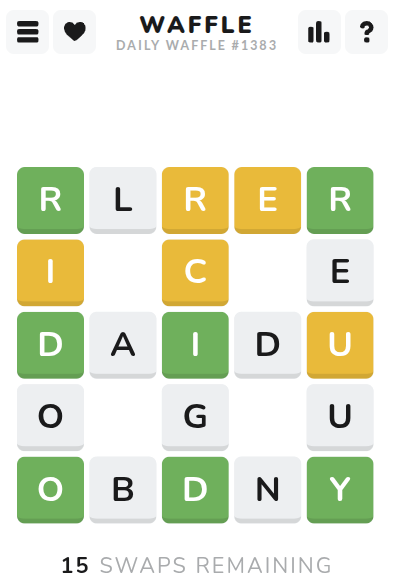
Bonus: Mondays have a “deluxe” version with a bigger grid.
OneWordSearch (puzzlist.com/onewordsearch)
A word search but you’re only looking for one specific word hidden in the grid. You swipe, the letters fall down, you search for another word.
StackDown (puzzlist.com/stackdown)
Letters stacked vertically: it reminds me of Mahjong. You need to form words by using letters from the stack.
Combinations (combinations.org)
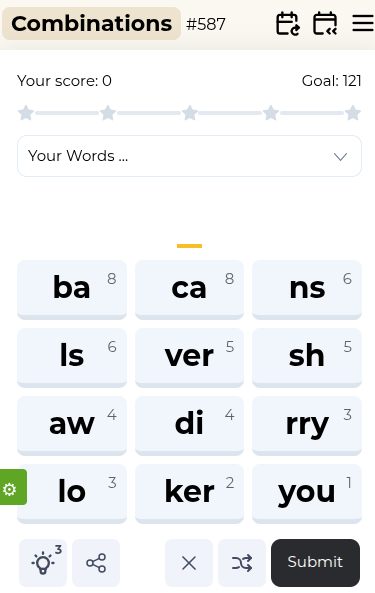
You’re given letter combinations (like “TH”, “ING”, “ER”). Build words using 2-4 combinations each. Seven-letter word = seven points. The goal is to find all words.
LinkedIn games
Then LinkedIn (linkedin.com/games). They’re actually well-designed:
Mini Sudoku - 6x6 grid. Classic Sudoku.
Zip - Connect colored paths across the grid without overlapping. Trace a continuous route.
Pinpoint - Five clues, each more specific than the last. Guess the word category as early as possible.
Crossclimb - Trivia-based word ladder. Find the right word and move it across the ladder to climb up. Each word shares one letter with the previous one.
Tango - Fill a grid with tiles matching some rules.
Queens - Place queens on a grid so none threaten each other. Each region needs exactly one queen. Spatial logic.
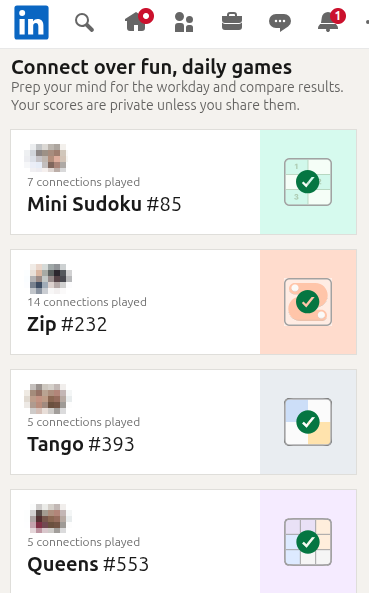
LinkedIn figured out that people crave mental engagement. Games keep you coming back daily, and while you’re there… you check your notifications. Fairly intelligent strategy, honestly.
NY Times
The heavy hitters (nytimes.com/crosswords):
Wordle - Six guesses to find a five-letter word. Green for correct letters in correct positions, yellow for correct letters in wrong positions. The most famous one.
Bonus: I also play par le (pietroppeter.github.io/wordle-it), the Italian version. Same rules, different language.
Strands - Find words in a letter grid that all relate to a hidden theme. Find the theme word, the “spangram”, to complete the puzzle.
Connections - 16 words, four categories, four words each. Group them correctly. The categories can be quite sneaky. The most difficult one, missing cultural and linguistic references.
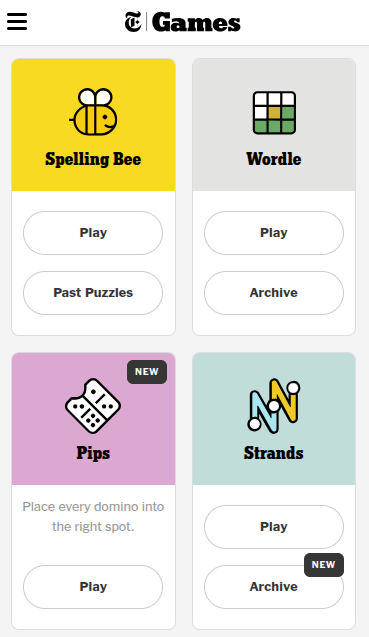
Mini Crosswords - RIP, not free to use anymore :(
Pips - Arrange domino tiles to match a target pattern. Different from word games, switches to visual-logical reasoning.
In the afternoon
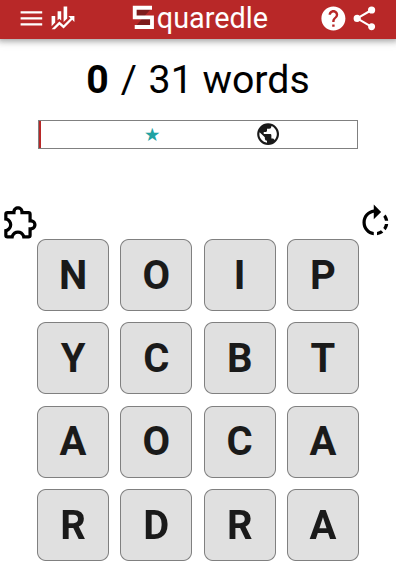
Squaredle (squaredle.app)
Find all words in a grid by connecting adjacent letters in any direction. Longer words score more points. Unlock three tiers of hints as you score. Bonus words like archaic or obscure terms don’t count for your score but appear on leaderboards.
What I dropped
Used to play geography games from teuteuf.fr. Worldle where you guess the country from its outline. Statele where you guess the US state. WhereTaken where you guess where a photo was taken.
I’m pretty enthusiastic about geography and related things, so at first it was great. But you know, there’s a finite number of countries, flags, and states. After a few months, you’ve seen them all. Pattern recognition replaced actual reasoning. Stopped being a challenge, became muscle memory so I dropped them.
Why it makes me feel better
The routine itself matters
Maybe you’ve seen tennis players serve routines. The routine isn’t always about superstition, as you could have been thinking. It’s about consistency. Your brain recognizes the pattern and knows what comes next. Same sequence every day helps developing consistency.
Jannik Sinner bounces the ball seven times before her first serve, five before her second. Every single time. This is not madness. The routine creates a mental state and helps concentration. Muscle memory for the mind.
My game routine aims to do the same thing.
Healthy competition
Most of these games have leaderboards or ways to compare scores. LinkedIn shows you how you ranked. NYT Connections shares results. Squaredle has daily leaderboards.
This creates healthy competition. Not life or death stakes, but enough to care. You want to beat yesterday’s score. You want to finish in fewer moves. You want to see your name higher on the board.
Competition keeps you engaged. Progress is motivating, even in something as small as a word puzzle. That’s why they keep adding badges.
And because everyone gets the same puzzle each day, it’s fair. You’re competing on equal ground.
Mental cross-training
Different games work different cognitive muscles:
- Word games - Waffle, Wordle, Combinations: Vocabulary and pattern recognition
- Logic puzzles - Sudoku, Queens, Tango: Deductive reasoning and spatial thinking
- Association games - Pips, Connections, Pinpoint: Lateral thinking and categorization
Cross-training for your brain. You wouldn’t only do bicep curls at the gym. You train different muscle groups. Same principle.
English language maintenance
Playing English games every day helps me keep my second language sharp. These puzzles force me to remember words I don’t use regularly and learn new ones, perhaps even unusual ones, to enrich my English conversations. And all of this without feeling like I’m studying!
Low-Stakes achievement
Puzzle games are the opposite of what you do at work, dealing with long projects, uncertainty, problems: immediate feedback, clear win conditions, achievable in minutes. You start your day with 10+ small victories.
Final thoughts
These games aren’t just time fillers. They’re mental maintenance. A daily warmup that keeps different parts of your brain engaged and active.
The routine builds consistency. The competition drives engagement. The variety ensures balanced cognitive training.
30-40 minutes every day isn’t much, but I really do feel better.
Wanna challenge me? ;)
Links:
- Waffle: wafflegame.net/daily
- Puzzlist (OneWordSearch, StackDown): puzzlist.com
- Combinations: combinations.org
- LinkedIn Games: linkedin.com/games
- NY Times Games: nytimes.com/crosswords
- Squaredle: squaredle.app
- Par le: pietroppeter.github.io/wordle-it
- Teuteuf Geography Games: teuteuf.fr